

Ghost’s all-in-one publishing platform helped propel 404 Media to profitability within a year of launch

Share this story:
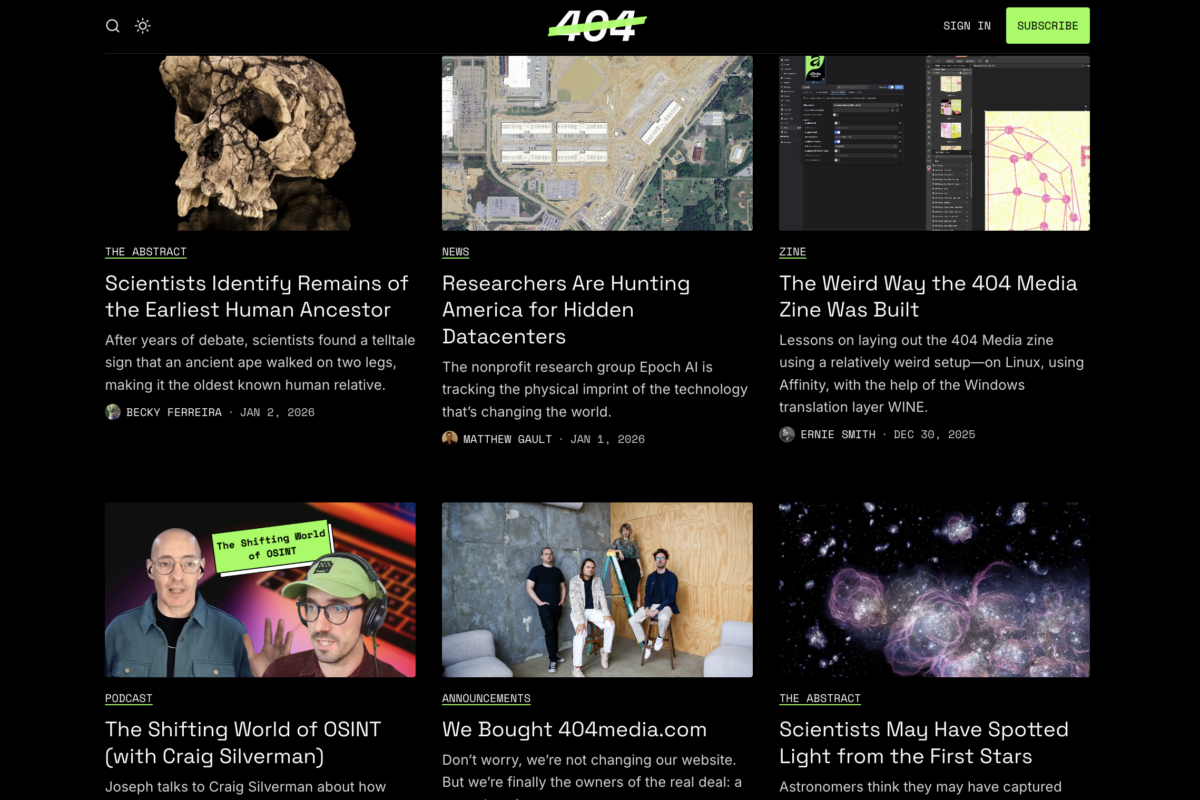
Finding the right platform is a crucial early decision for digital media outlets. Establishing a stable and successful home on the web shapes how an outlet grows its audience and its business.
For small independent organizations that don’t have a ton of money to spend on web design and don’t want to yoke themselves to a restrictive or unpredictable platform, it can be tough to find the right publishing venue.
This was one of the first hurdles faced by 404 Media, a technology-focused investigative reporting outlet founded by former Vice journalists Jason Koebler, Sam Cole, Joseph Cox and Emanuel Maiberg. Spun up in 2023 during Vice’s bankruptcy proceedings, 404 Media started out with almost no funding and very little runway.
“We didn’t take any VC funding — we didn’t seek any but we knew that no one was knocking down the door offering to give VC funding,” 404’s Koebler says. “We knew that we had to make money from day one.”
In order to start bringing in revenue, 404’s founders needed an online platform to publish articles, amass an audience, and turn that audience into a support base of paying subscribers. They found their solution in Ghost, a nonprofit organization making open-source tools for web publishing.
Ghost bills itself as an all-in-one media publishing platform: Out of the box, it lets customers build a website, write and publish content, collect subscribers for newsletters, and — importantly — establish paid subscription tiers gating premium content. Koebler credits Ghost for being an easy-to-use, effective publishing platform that lets 404’s work start reaching audiences quickly and its open-source nature gives 404 more control over their platform and the effort they put into building a successful media startup.
Three reasons to use Ghost
- Ghost’s suite of publishing tools simplify the process of setting up and running a digital publishing platform.
- Ghost’s professional options are a flat monthly fee rather than a cut of revenue, making it potentially the cheapest set of robust publishing tools on the market.
- Ghost’s open-source and nonprofit business model gives its clients more ownership of the platforms they build.
Newsroom overview
In 2023, Vice Media filed for bankruptcy after shuttering its high-profile newsrooms and laying off over 100 of its journalists. The proceedings spurred some Vice employees, including Koebler, to start looking for an exit strategy. Koebler, a 10-year veteran of the company who was editor-in-chief of the outlet’s tech brand Motherboard, says 404’s founders were inspired by a trend of small journalist-owned publications popping up in the wake of other media layoffs and closures.
“We had seen the rise of Defector, where journalists started their own publication,” Koebler says, “and we started thinking ’maybe this is something we could do also.’”

404’s small team (four founders plus several freelance writers) focuses on the kind of tech news coverage they honed at Motherboard: ground-breaking scoops at the intersection of tech, culture and policy. Their strategy relies on regularly publishing eye-catching, impactful stories that would consistently grab the attention of their target audience.
“We just had this belief that if we consistently kept publishing good articles, that over time things would snowball and we would get to a place where we felt secure and sustainable,” Koebler says. “And thankfully I would say within about six months, it was clear we were getting to a place where the audience growth was enough, the subscriber growth was enough. It was working.”
The Problem: Affordable platform, ownership of content
404 Media’s business model needed platform solutions for content management and publication, membership signups and email collection, newsletter distribution, paywalling and subscription management, and payment processing. With a small staff, tight budget and short timeline, 404 Media needed to get as much value as they could out of their chosen platform.
An additional concern for 404 Media was ownership of their site and the content they published. It’s difficult to migrate an established audience away from closed platforms like Patreon or Substack, both of which can make clients vulnerable to sudden policy shifts or noxious moderation decisions. Small outlets rely on trust and rapport with their audience, so picking the wrong platform could leave 404 stranded on a service that’s suddenly the wrong fit.
The Solution: An open-source powerhouse
Ghost launched in 2013 following a successful Kickstarter campaign to build “an open source blogging platform which makes writing pleasurable and publishing simple.” The organization is structured as a nonprofit foundation, operating without having to answer to investors or shareholders.
The technology behind Ghost is also open source, which means anyone is free to use, develop or change it for their own projects. According to their public financial metrics, Ghost has over 27,000 active customers, and its software has been installed over 100 million times.
404 Media ultimately went with Ghost because it addressed those two major problems: it gave the company a solid and intuitive toolkit at a good price point, and it offered concrete assurances that 404 could control their own site.
The heart of Ghost’s publishing tools is its content management system, which Koebler describes as “a breath of fresh air” compared to his previous CMS experiences. Ghost’s CMS is easy to use and intuitive, while still robust enough to handle a wide range of content. Combined with tools for website building and subscription gating, Ghost enabled 404 to quickly set up their whole outlet within one platform.
Although Ghost lets its customers jump straight into publishing, Koebler does note that 404 really benefitted from using the third-party tool Outpost, which augments Ghost’s analytics and autoresponse tools to help onboard and manage new members. The site also got some design and technical help from another former Vice employee, which gave 404 a unique look and feel.
Ghost charges a flat fee for their services, ranging from $15-$200 a month. Koebler says that was a more attractive proposition for 404 than the percentage cut model used by other platforms. “The idea of sort of signing up to give 10% of any money we made away to another company was not something that we really wanted to do,” Koebler says.
Ghost’s open-source and nonprofit structure also gives 404 more control over their outlet, which Koebler said was a major draw. As a nonprofit, Ghost doesn’t have to worry about maximizing the revenue they make off of their customers — one of the reasons they’re less worried about locking users into the Ghost ecosystem. And if the Ghost organization ever does go in a direction 404 doesn’t like, the outlet always has the option of spinning up its own branch off of Ghost’s open-source code, preserving their vision of the site and the audience they’ve built.
The Impact: Audience growth, profitability within a year
Since its founding, 404 Media has broken major stories on the tech companies aiding mass government surveillance efforts, the growing wave of AI deepfake porn bots, and major hacks of sensitive data. The outlet’s also involved in multiple lawsuits pressing the U.S. government for more details on their surveillance policies and use of personal data.
Ghost’s simple and effective publishing platform allowed 404 to ramp up to a professional publication quickly and efficiently. The company announced they were profitable in 2024 — just a year after launch — and Koebler says their support base has only grown faster with time. “I think there’s a word of mouth effect that as you get more subscribers, there’s more people who see our stories, so there’s more people sharing our stories, so on and so forth,” Koebler says.
When they first started out, 404 initially focused on encouraging readers to become paid subscribers; a strategy that ended up neglecting building a consistent audience of free users and hindering the outlet’s growth. After course correcting, Koebler says free signups are the site’s main source of subscriber growth.
“People are essentially trying you out,” Koebler says. “Over time, if you do enough good work, a lot of those people are willing to convert to become paid subscribers.”
Verdict: Ghost is affordable and can grow with an organization
The rise of the small, independent digital newsroom necessitates simple, affordable tools that can get a publication off the ground. Ghost strikes a balance of affordability, utility and independence that make them an attractive option for newsrooms of all sizes.
404’s success as an outlet is first and foremost due to their tenacious reporting work; but Ghost’s platform helped that work shine and reach loyal audiences.
Alternatives for simple, all-in-one digital publishing
Ghost is one of many options in a crowded market of web publishing services. While Ghost was the right call for 404, there are a few other considerations that might make a different platform a better fit.
As mentioned, Ghost is on the cheaper end of digital publishing services. But if you’re especially price-conscious, sites like Medium offer free, no-frills blogging on their own platform. Substack, Beehiiv and Patreon also operate by charging a share of revenue rather than a flat fee. While that pricing scheme was a no-go for 404, it might fit better for a more modest operation.
On the other end of the spectrum, if you want something more customizable and with more tools, WordPress is a good option that may come at a steeper price depending on your host, plugins and other factors (though Ghost has several built-in functions that would require add-ons and more cost for WordPress).
When it comes to digital publishing, Substack is probably Ghost’s major competitor as they both offer simple yet effective publishing tools. Substack also offers an easy path to grabbing a big audience — the site’s network of referrals and promotions allows publications to attract attention within the platform itself.
But Koebler notes simply reaching a big audience doesn’t always mean more subscribers. “What we’ve found is we’ve been able to build a really sustainable, really engaged subscriber base on Ghost,” Koebler says, “and I don’t think we have any sort of regrets about that.”
Share this story: