
Inside Digital Trends’ selection of TollBit to help monitor AI traffic to its website

Share this story:

Dan Gaul helped launch Digital Trends, one of the largest independent tech media sites in the U.S., in 2006 during what he calls the “Wild West days” of online publishing. Back then, the formula was simple: create content, optimize for Google, watch the traffic roll in. Display ads and affiliate links funded the operation and the clicks were high.
Today, AI scrapers harvest millions of pages from Digital Trends every week while sending back a few thousand human visitors, creating an existential challenge for the Portland, Oregon-based company. Search traffic is drying up as AI overviews replace traditional links. The platforms that once fueled growth are now competing directly for audience attention.
To survive this transformation, Gaul says publishers need to rethink how value is exchanged online — not just with human readers, but with the autonomous bots that increasingly dominate web traffic. That realization led him to TollBit, a platform that helps publishers monitor, manage and monetize AI bot access to their content.
Three reasons to use TollBit
- TollBit provides detailed analytics on which AI bots are accessing your content, how often, and which pages they’re reading — data that Google Analytics doesn’t capture
- The platform creates a marketplace where publishers can set prices for bot access and potentially license content to AI companies without negotiating individual deals.
- Implementation is lightweight for monitoring purposes, requiring just a simple JavaScript tag and no upfront or monthly fees.

Newsroom Overview
Digital Trends covers consumer electronics, smart home technology, gaming, and lifestyle content through its flagship site and eight additional verticals spanning home design, men’s fashion, and food. The company remains privately held and independent since its founding nearly two decades ago.
The company once employed 170 people, most in editorial roles. But the one-two punch of COVID’s impact on advertising budgets and the rise of AI overviews has been brutal. Today, Digital Trends relies primarily on freelancers after downsizing. “It’s really hard to maintain a huge workforce when we don’t have private equity or large media dollars behind us,” says Gaul
The shift to a predominantly freelance model brought its own complications, including concerns about whether contributors might be submitting AI-generated content. But the bigger threat was AI’s hollowing out the pay-per-click model Digital Trends had relied on for years.
Problem: Traffic without compensation
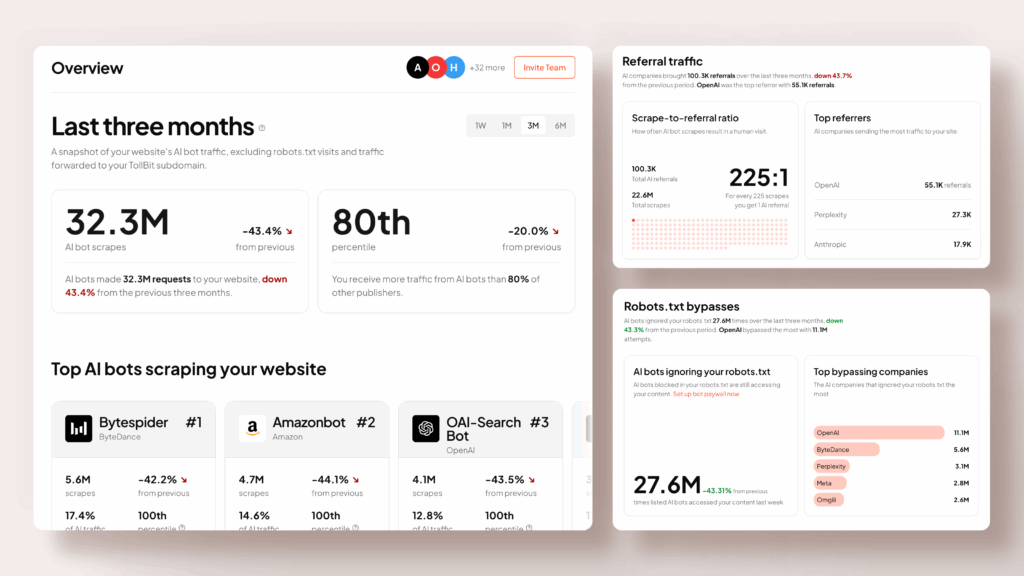
When Gaul pulls up TollBit’s analytics dashboard, the numbers tell a stark story. In the past week alone, Digital Trends received 4.1 million bot scrapes. During that same period, AI chatbots referred just under 4,200 human visitors back to Digital Trends. “966 AI scrapes to one referral,” Gaul says. “It’s crazy.”
This lopsided relationship represents the core problem facing publishers in the AI era. AI overviews — those AI-generated summaries now appearing atop many Google searches — dramatically accelerated this shift. Digital Trends saw traffic drop as users got their answers directly from Google without ever clicking through to the underlying sources.
“The only time people are clicking through to a publisher is [when] they don’t trust what AI overviews are saying, or they’re looking for more detailed information,” Gaul says.
The impact varies by content type. Evergreen content, like “how to take a screenshot on Windows,” took the hardest hit because they’re perfect for AI to answer with specific, step-by-step instructions without attribution. Reviews of consumer electronics similarly suffered as AI could aggregate specs and ratings from multiple sources.
“Information that is data-centric or spec-centric I think is where publishers are getting hurt most,” Gaul says. “And where they’re getting hurt the least is more on the featured, editorial, creative writing stuff.”
Meanwhile, some hosting providers began charging publishers for the bandwidth consumed by bot traffic. Digital Trends was fortunate to use a provider that didn’t penalize them for scraper traffic, but Gaul heard from other publishers facing double punishment: losing human traffic while paying to serve content to bots.
Solution: A tollbooth for the AI web
TollBit is a response to how the web’s primary consumers were shifting from humans to autonomous agents — bots, scrapers, and AI applications that read and process content without human direction. TollBit co-founder Toshit Panigrahi realized this shift required fundamentally new infrastructure.
“For human visitors, you have ads, you have subscriptions, you have affiliate links,” he says. “What do you have for autonomous visitors? Until TollBit, there was no way to have an exchange of value.”
TollBit operates on what Panigrahi calls the “three Ms”: Monitor, Manage, and Monetize.
Monitoring provides detailed analytics about bot behavior that traditional tools like Google Analytics miss. Publishers can see which bots are accessing their content, how frequently, which specific pages are being scraped, and how many human referrals they receive in return.
Managing gives publishers control over bot access conditions. Unlike cybersecurity firms that play “Whack-A-Mole” with malicious scrapers, TollBit focuses on creating what Panigrahi calls a “happy path” by making it easy for AI companies that want to behave ethically to license content properly.
“If we are in the Napster days, what does the Spotify solution look like?” Panigrahi asks. “If someone wanted to behave well, how do they come and get access to those articles?”
Monetizing enables publishers to set prices for bot access, either per crawl or through licensing agreements. TollBit’s marketplace allows AI companies to discover and license content from multiple publishers without individual negotiations.
Impact: Data now, revenue later
Digital Trends hasn’t implemented TollBit’s monetization features, so the platform hasn’t directly affected traffic or delivered revenue yet. But the monitoring data has already proven valuable for informing future content and business strategies.
Analytics revealed that ChatGPT’s user bot scrapes Digital Trends far more aggressively than other bots. Over the last month it accounted for 3.6 million scrapes — 87.8 percent of all AI bot traffic to the site.The homepage gets scraped most frequently as bots check for fresh content. The top individual article scraped on Digital Trends in October 2025 was “Instagram finally fixes the one thing you hated about Reels,” a timely news story without lasting SEO value. Gaul is unsure why this article led to a spike in bot traffic, but he is hopeful that over time monitoring will reveal long-term trends.
Gaul remains realistic about monetization, saying he doesn’t expect TollBit to bring in a ton of revenue for Digital Trends right away. “We’re just not there yet in terms of the whole AI ecosystem,” he says.
Long-term potential exists, especially as TollBit’s network grows and bargaining power increases. Those benefits could help big and small outlets alike negotiate better terms with AI companies.
For now, human visitors are still Digital Trend’s primary revenue source. “At the end of the day, it’s going to be about community,” Gaul says. “How do you build community without relying on Google?”
Security and privacy
TollBit presents minimal security risks for publishers willing to experiment. The monitoring feature requires only a JavaScript tag, similar to Google Analytics, without accessing backend systems or sensitive data. Publishers retain full control over which bots can access their material.
In the product, TollBit operates as a processor/service provider for publishers under a Data Processing Agreement (DPA). It processes limited personal data (e.g., visitor IPs to detect bot scraping) under your instructions, does not sell or “share” that personal data, and uses subprocessors subject to security and contractual controls. For more information on security and privacy view TollBit’s Publisher Terms of Service.
Verdict: Free, low-risk monitoring, long-term potential
TollBit represents a low-risk experiment with potentially significant upside. The monitoring features are free and relatively easy to implement, providing valuable data about bot behavior without requiring major technical investment or workflow changes.
The monetization side is still emerging. Publishers set the rate AI companies must pay to access their content, and TollBit adds a small fee on top, charged to those companies. While the revenue potential is speculative, the long-term vision — creating a licensing marketplace for bots — could yield meaningful income, especially if adopted widely.
The team at TollBit thinks the amount of bot traffic coming to news sites will only continue to increase and with it, the possibility of a sustainable revenue source for publishers. “These AI companies are coming tens of thousands of times a day to your site. It’s not that they just crawled it once, took the content and left. They need to access this regularly,” Panigrahi says.
Gaul’s advice for other publishers considering TollBit: Be clear about your goals and realistic about expectations. Gaul maintains that while you might not see immediate returns right now, understanding what’s happening with bot traffic and AI scraping on your sites is essential. “The value of TollBit is the knowledge.”
Alternatives to TollBit
CDN/WAF bot mitigation (Cloudflare, Akamai, Fastly, etc.)
- Detect and block or challenge automated traffic at the edge.
- Mature security features (managed rules, rate limits, anomaly detection); protects performance and infrastructure.
- No licensing/monetization — it stops bots rather than charging them. Requires tuning to avoid false positives and protect SEO.
- Tiered plans/self-serve and enterprise contracts (varies by vendor).
- Attribution and monetization for AI answers. Includes Gist Answers, a site-hosted AI search tuned to your content and a licensed library.
- Ad-supported with a 50/50 revenue split; publisher share is allocated by each source’s contribution to the answer.
- The suite of tools offers On-site AI Q&A, attribution reporting, and a monetization path that doesn’t require a paywall or API.
- It is not an edge-layer blocker or licensing paywall; ProRata can be used in tandem with TollBit or CDN bot blocking.
- AI search visibility analytics — similar to TollBit’s monitoring, but without licensing/monetization features.
- ScalePost shows where your content appears in AI answers, whether you’re cited, which articles feed ChatGPT/other models, and if bots respect robots.txt; includes visibility scores and prompt/answer analytics.
- It is also not an edge-layer blocker or a licensing/paywall system. Use alongside TollBit/CDN/WAF if you want enforcement or revenue.
- Pricing starts at $49/month for the basic plan.
Share this story: