
The newsroom-built AI transcription tool that protects your sources

Share this story:
When Jacob Granger headed to a five-day journalism festival packed with panel discussions, he needed a transcription tool that was fast, accurate and budget-friendly. More importantly, he needed one he could trust.
Granger, a senior reporter and podcast host at journalism.co.uk, chose Good Tape — a transcription app born in a Copenhagen newsroom. That journalism pedigree gave him confidence in something many transcription services overlook: data security.
“When you’ve got software that has been built by people in your profession, rather than just an abstract tech company, I think that gives you a bit more faith in the values of how they’re handling the data,” he said.
Good Tape delivered. Through a series of panels and rapid-fire story production that week, the tool provided Granger with the speed he needed without compromising the all-important source protection that journalism demands.
“It was a bit of a baptism by fire,” he said. “It was a big workload. I did numerous stories that week from the festival, and it just really gave me a leg up.”
Good Tape case study highlights
- In addition to transcripts, Good Tape can produce time-code annotated, AI-generated summaries. An AI-driven chat feature highlights key points and allows users to ask questions about the content of the transcript.
- As a newsroom product, Good Tape places high importance on data security and does not train its AI models on users’ transcripts.
- Good Tape is cheaper than other transcription apps—but offers fewer bells and whistles.
Overview
Journalism.co.uk, founded in 1999, covers emerging media trends for industry professionals through its daily newsletter (17,000 subscribers) and website. The publication also hosts the annual Newsrewired conference series, digital publishing events featuring talks, panels and workshops on journalism innovation.
Granger is the lead writer on the three-person staff, producing daily coverage and hosting a weekly podcast. The company’s recent ownership change has sparked plans for major transformation with an emphasis on AI integration, making Granger’s hands-on experience with transcription tools especially relevant to journalism.co.uk’s evolving coverage.
The problem: Transcription tedium
Every journalist knows the tedium of transcription. Good Tape originated from Danish outlet Zetland’s newsroom, which primarily publishes long-form audio content. This means reporters conduct hours of interviews every week, and they’re frequently overwhelmed by audio files, spending hours transcribing them.
Good Tape was specifically designed to solve this problem.
“Those hours were just super boring and the journalists didn’t want to do it,” said CEO Tav Klitgaard. They “might be spending five, six, seven hours per week basically being robots, and they hated it.”
But at lunch one day in late 2022, a Zetland journalist complained to staff programmer Jakob Steinn about the burden of transcription. Speech recognition tools on the market then were especially bad at handling Danish, but Steinn knew OpenAI had just launched its open-source speech recognition system, Whisper.
The first version was slow but transformative.
“The next morning, this journalist just comes running into my office and says, ‘OK, stop everything you’re doing. Allocate all resources to this project … because it’s magic,’” Klitgaard said. “It’s not that often that you see grown people almost in tears over something that technology has done for them in their professional life.”

The Solution: Journalist-first by design
Zetland spun off Good Tape as a separate company in 2023. Since then, the company says it has gained 2.5 million users with its straightforward approach: accurate transcription with features journalists actually need.
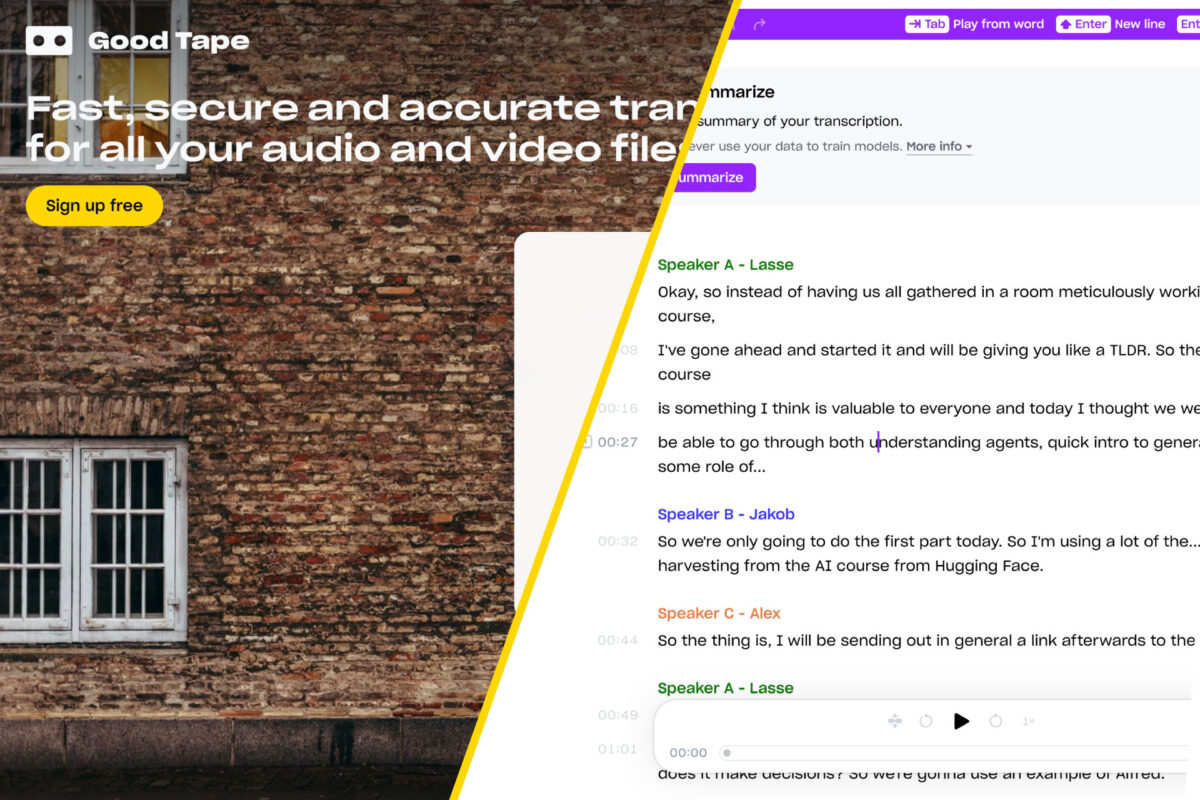
The app generates time-coded transcripts that the user can edit, highlight and share with colleagues. It identifies different speakers and allows users to click on any word to jump to that audio moment—essential features for fact-checking and finding sound bites.
Good Tape’s AI-generated summary adds value without overwhelming, helpfully including time codes when each topic is discussed. An AI chat feature allows users to ask questions about the transcript, and the AI-driven “smart search” looks for relevant information across all the user’s transcripts. The company says it can uncover “insights that may be hidden in your tapes.”
Granger praised Good Tape’s accuracy and reliability and for “not fabricating information, which has happened a number of times on other platforms I’ve used,” he said. Those services “do really reach for connecting dots where there aren’t dots to be (connected).”
The impact: Journalists get time back
For a newsroom like Zetland, where reporters conduct numerous interviews for long-form stories, Klitgaard estimates that Good Tape saves three to six hours per week per journalist. While it’s hard to measure increasing output precisely, he said, it lets reporters spend more of their time reporting and writing.
For daily news reporters like Granger, the impact is equally significant. “You’re doing more of the journalism and less of the tedium.”
The competition: More features, but more money
Good Tape trades bells and whistles for affordability and simplicity. It doesn’t integrate with Slack, Google Drive or other apps and there’s no mobile app. But its developers say these features are coming soon. This currently puts it behind apps like Otter, Alice, Trint and Descript.
Where Good Tape excels is price. For $17 per month ($185 annually) users get 20 hours of transcription with unlimited files. Compare that to:
- Otter.ai: Similar monthly costs but caps users at 10 files.
- Descript: $24 monthly for just 10 hours of transcription
- Trint: $52 monthly for only seven files.
Security and privacy
The company says data security is paramount. As the product of a newsroom, the company understands that leaked recordings can destroy careers, endanger sources and compromise investigations.
When a reporter uploads a recording of a confidential source, “it cannot leak and you cannot train any models on it,” Klitgaard said.
Good Tape hosts its AI model on EU-based servers, adhering to strict European data privacy laws, which are more stringent than those in the United States. The company encrypts its data using AES-256, the same standard used by the U.S. government for classified data. Most importantly, Good Tape never trains its AI models on user data.
That was a key feature for Journalism.co.uk’s Granger, who has covered how tech companies consume copyrighted material for AI training. “I don’t think you can underestimate the value of Good Tape being very data and security conscious,” he said. If a company trains on journalists’ interviews, “we’re giving away a very valuable part of our work to benefit (AI companies).”
The verdict
Good Tape won’t replace big transcription suites for complex multimedia projects. However, for budget-conscious newsrooms (i.e., all of them) seeking reliable, secure transcription without feature bloat, it delivers precisely what is needed.
Protecting sources and controlling costs both matter. And Good Tape’s newsroom origin shows that sometimes the best tool for journalists is one built by journalists.
Share this story: