
Using AI like a data journalist | Help Desk Monthly

Share this story:
Note from the editor
The Help Desk was in Indianapolis last week for the news industry’s favorite nerdy journalism conference: NICAR. The annual Investigative Reporters and Editors event focuses on all things data journalism.
Normally, this conference is THE place to go if you’ve ever wanted to know how to wield a spreadsheet, code in Python or R, build a web scraper, or visualize data using maps or other graphics. Those who enjoy working with data return to NICAR because the event is also THE place to keep data skills up to date as technology advances.
NICAR felt like a very natural home for sessions and discussions about artificial intelligence. “How to get data out of complex documents using AI” and “Editing the machine: Fact-checking AI-assisted reporting in the newsroom” were just a few of the many sessions this year merging AI best practices with traditional data journalism.
Normally, when I talk with journalists about AI, they shift to trust very quickly, and that’s where the talk ends. But at NICAR, the conversation didn’t stop at trust and has even evolved beyond that because these journalists aren’t strangers to using code to serve their audiences. Using the same logic that’s applied to Python or SQL, what’s important is that journalists can verify the AI’s output.
Code reviews, debugging and other spot-checking tactics help data journalists ensure that their articles are ironclad and ready for publication. Using AI to get to the output faster doesn’t change the need for human review and fact-checking.
If you’re on the fence about using AI, ask yourself what’s at the core of your hesitation. The answer can be your rubric for evaluating an AI tool. And checking the AI’s work should always be part of your process.
Remember, you’re a journalist, and fact-checking has always been integral to what you do — so you’re already equipped to work with AI.
Sincerely,
Leah Becerra, Product Director at News Media Help Desk
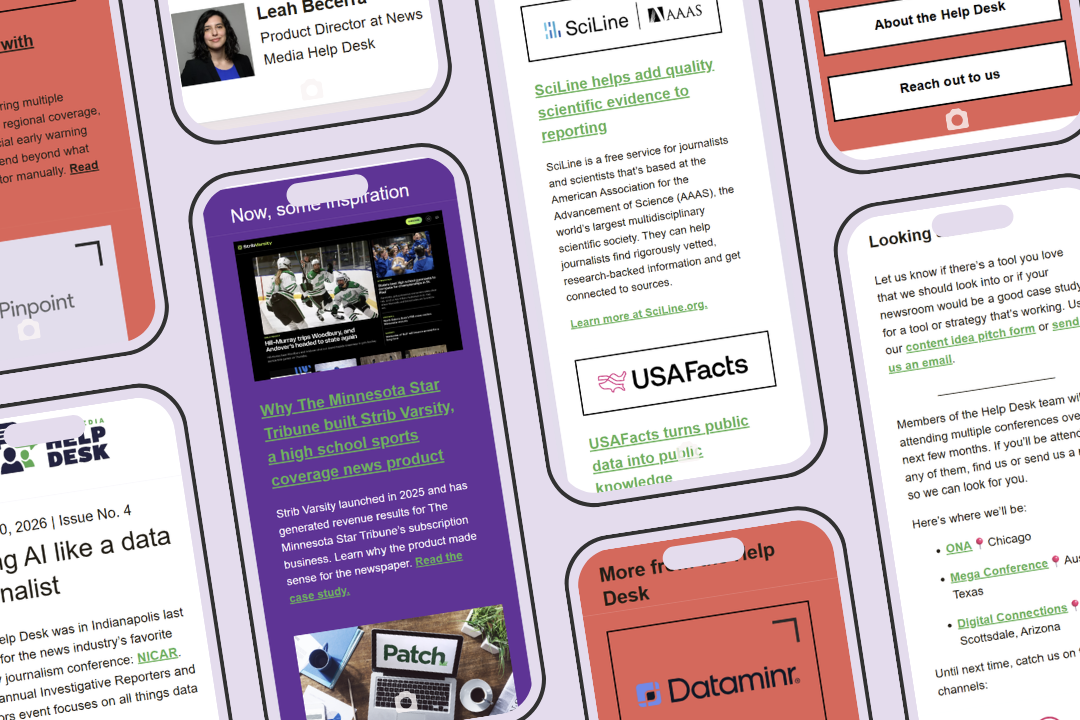
Now, some inspiration
Why The Minnesota Star Tribune built Strib Varsity, a high school sports coverage news product.
Strib Varsity launched in 2025 and has generated revenue results for The Minnesota Star Tribune’s subscription business. Learn why the product made sense for the newspaper.Like a police scanner for multiple cities, Dataminr helps Patch detect breaking news across the U.S.
This AI platform provides targeted alerts for developing stories to transform a flood of public information — from social media posts to traffic cam footage — into manageable news streams.Vibe coding for journalists: Build interactive stories without writing a single line of code
The term vibe coding came out of developer culture, but it is no longer just for developers. It’s for anyone who wants to tell a story that harnesses the power of coding.The Current uses Nota’s AI tools to expand the small news team’s digital capacity
Nota offers newsroom-specific AI help for headlines, content summarization and social media. Take a look at how it’s helping The Current’s small news team.Getting started with Dataminr
For newsrooms covering multiple markets or providing regional coverage, Dataminr offers crucial early warning capabilities that extend beyond what reporters can monitor manually.Getting started with Google Pinpoint
The tool’s integration with Google’s knowledge graph and automatic tagging capabilities can wrangle overwhelming FOIA dumps into searchable, organized archives.Getting started with Utopia Analytics
By adapting to a publication’s unique voice and community standards, this tools helps news publishers maintain civil discourse in the comments.Other resources worth your time
SciLine helps add quality scientific evidence to reporting
SciLine is a free service for journalists and scientists that’s based at the American Association for the Advancement of Science (AAAS), the world’s largest multidisciplinary scientific society. They can help journalists find rigorously vetted, research-backed information and get connected to sources.Learn more at SciLine.org.
USAFacts turns public data into public knowledge
USAFacts is a not-for-profit, nonpartisan civic initiative that aims to make government data easier to access and understand. Journalists can use the data in their reporting on topics like the economy, government spending, health, immigration, education and more.Get more information at usafacts.org.
Here are four brand new resources created for journalists, by 2025-26 RJI fellows
Grants for Journalists by Monica Williams
This database connects independent journalists, staff reporters and newsrooms with a range of funding opportunities. (Go to the database 🔗)
Covering Immigration by Claudia Yaujar-Amaro
This bilingual toolkit is designed to enable any journalist in the United States to cover immigration accurately, ethically and with dignity. (Go to the toolkit 🔗)
Powering News by Tara Francis Chan
This project aims to support non-traditional, worker-friendly newsrooms: co-ops, staff-led nonprofits and other democratically-run newsrooms (often called worker-led or worker-run newsrooms). (Go to the project 🔗)
Covering Drugs by Susan Stellin
Download this 140-page resource guide listing key surveys, reports, data sets, studies, research hubs and other information useful to journalists reporting on drugs and alcohol. (Download the guide 🔗)
Looking ahead 👀
Let us know if there’s a tool you love that we should look into or if your newsroom would be a good case study for a tool or strategy that’s working. Use our content idea pitch form or send us an email.
Members of the Help Desk team will be attending multiple conferences over the next few months. If you’ll be attending any of them, find us or send us a note so we can look for you.
Here’s where we’ll be:
- ONA📍Chicago
- Mega Conference📍Austin, Texas
- Digital Connections📍Scottsdale, Arizona
Until next time, catch us on these social channels:
Share this story: